English
 Türkçe

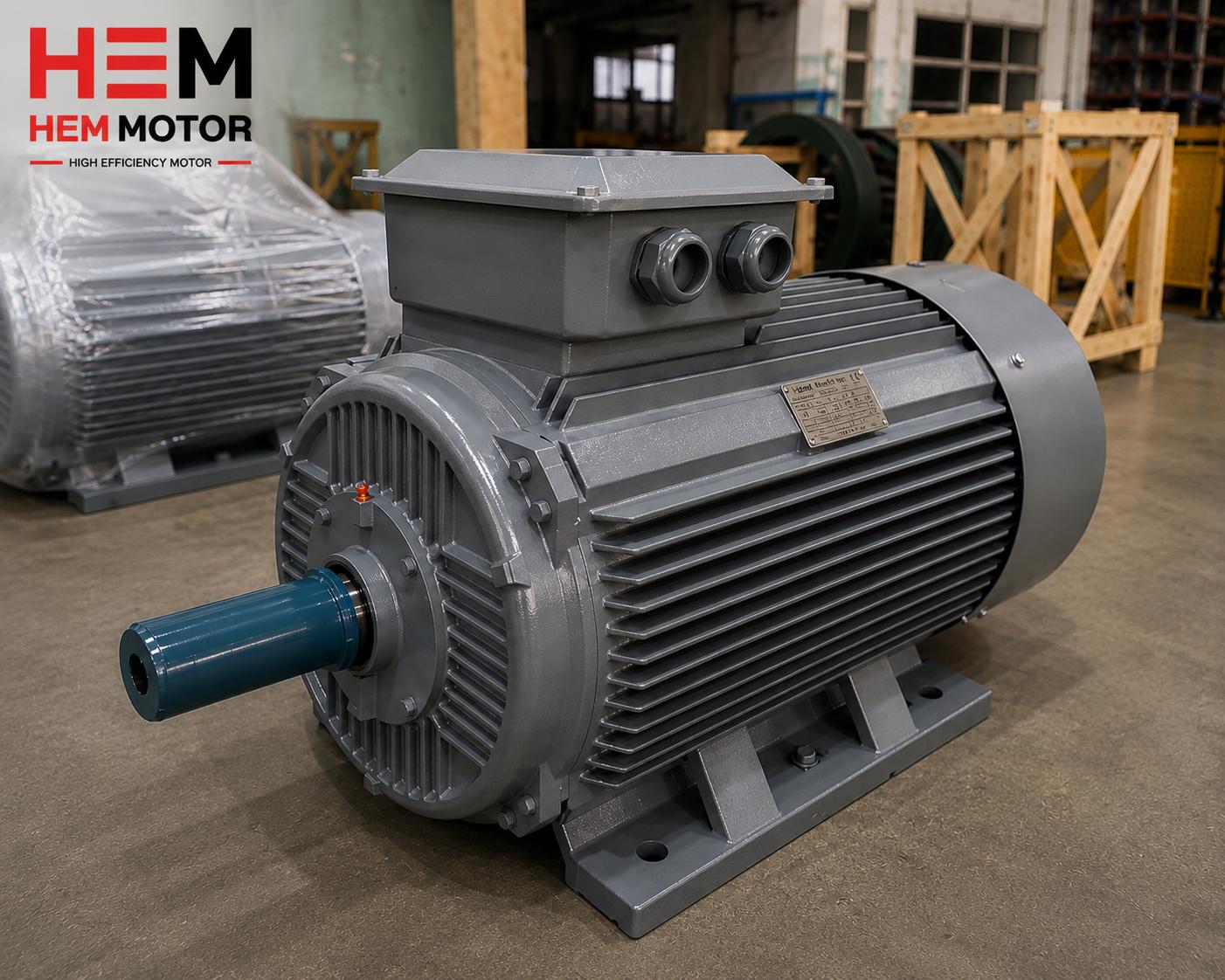

When setting up a generator-powered facility, construction site, greenhouse, irrigation line or backup supply system, the most frequently asked question is this: "Will the generator I have handle this motor?" A generator whose power is sufficient on paper but which drops in speed and trips into protection or collapses the voltage as the motor starts is the biggest headache for buyers. This article addresses generator sizing from the purchasing decision point of view: how many kW of motor a generator of how many kVA really handles, why starting current is decisive, and how to get the job done with a smaller generator using a soft starter or a frequency inverter (VFD). HEM Motor, as an electric motor factory manufacturing since 1979, supplies your motors from Türkiye stock together with a starting recommendation suited to your generator.
kVA and kW Are Not the Same: First Understand the Power Factor
Generators are labeled in kVA (apparent power), while electric motors are labeled in kW (active power). The bridge between the two is the power factor (cosφ). For a standard generator a typical power factor is taken as 0.8; that is, the active power a 100 kVA generator can continuously deliver is about 80 kW. Looking from the other direction, to convert an application's active power requirement to kVA you divide the kW value by 0.8: the equivalent of a 40 kW load is roughly 50 kVA. This conversion is also the source of the first mistake made in generator selection; many buyers think kVA and kW are equal and select the generator smaller than it should be.
However, the power factor is only half of the calculation. The truly demanding side of asynchronous motors is not the continuous operating power but their behavior at the moment of starting. A general purpose industrial motor, even while drawing its rated power in continuous duty, demands a current far above this in the first seconds. It is precisely this starting surge that is decisive in generator sizing, not the continuous power. That is why the logic of "this motor is 40 kW, my generator is 50 kVA, fine" most often fails in the field.
Practical Conversion from kW to kVA
In practice you can use the following chain: the motor's shaft power (kW) → because of motor efficiency the electrical power it draws from the mains is slightly higher → divided by the power factor it is converted to kVA. Approximately, allocating 1.3 to 1.5 kVA of generator capacity for 1 kW of motor power in continuous duty is a reasonable starting point. This ratio is only for continuous operation; it does not account for starting. We give the practical rule that also covers starting current in the next section.
You should also not overlook the motor's own power factor. An asynchronous motor running with no load or at low load operates at a low power factor; that is, even though the active power it draws from the generator is small, its apparent power (kVA) demand may be disproportionately high. This situation strains the generator unexpectedly, especially in motors that have been selected larger than necessary and are continuously turning at low load. For this reason, selecting the motor larger than necessary in generator-fed systems is a double mistake: both the initial investment increases and the low-load power factor runs the generator inefficiently. The right approach is to select the motor close to the actual load requirement and size the generator accordingly.
Starting Current: 3 to 7 Times the Rated Current
A three-phase three-phase asynchronous motor, when starting from rest with direct online (DOL) starting, draws a current of approximately 3 to 7 times the rated current; in standard industrial motors this ratio is typically around 6 times. In a mains-connected facility this surge is absorbed inside the powerful transformer behind it and most often is not even noticed. With a generator the situation is completely different: behind the generator there is not an infinitely powerful grid but a limited-power diesel engine and a limited alternator. The sudden current demand causes a voltage drop in the alternator and a speed and frequency sag on the diesel side.
Here a vicious cycle comes into play: as the voltage drops, the torque the motor produces decreases with the square of the voltage, when the torque drops the starting lengthens, and as the starting lengthens the motor continues to draw a high current. The result is either the generator tripping on its low-frequency protection or an incomplete start that heats the motor winding. For this reason, what is decisive in generator selection is not the total kW in the facility but the starting surge of the single largest motor. A generator that feeds twenty small motors without a problem can buckle at the direct start of a single large motor.
Practical Rule for DOL: Generator ~3 Times the Motor Power
In cases where direct online (DOL) starting is used, the practical rule considered safe in the field is this: the kVA value of the generator should be about 3 times the kW value of the largest motor that will start directly. That is, to start a 15 kW motor on its own with direct online starting, a generator of roughly 45 kVA is targeted. This ratio includes a margin to absorb the starting surge; a generator selected much smaller will collapse the voltage at start even if the motor is 15 kW. This multiplier is a conservative starting value; it narrows or grows according to the motor's actual starting class, the generator's transient overload capacity and the state of the other loads.
Understanding why this rule is 3 times is the key to selecting the right generator. The motor draws about 6 times the rated current at start, but not all of this current strains the alternator as apparent power; at the moment of starting the power factor is very low and generators can withstand short-term transient overloads to a certain extent. When all these factors combine, a margin of about 3 times the continuous power safely covers the starting of most standard motors. However, the point not to be forgotten is that the generator manufacturer separately states a "motor starting" kVA value; a generator's continuous (prime) power and the transient power it can deliver for motor starting are different values. Knowing both of these values for your generator at the quote stage lets you make the motor match much more robustly.
In facilities where more than one motor is fed from the same generator, sequencing is also important. Bringing the motors online not at the same time but from the largest to the smallest, or in stages, ensures that each starting surge is met on its own. Thanks to the motors starting in sequence with automation (a staged starting scenario), a facility that would otherwise require a very large generator can run with a generator of a more reasonable size. This is an engineering choice that significantly lowers the generator cost in the purchasing decision.
Practical Matching Table (DOL, Single Motor)
The table below shows the approximate generator size when a single motor is started with direct online starting. The values are an initial target; the final selection must be clarified according to the motor's starting current class and the generator's transient load capacity.
- 1.5 kW motor: ~5-6 kVA generator
- 4 kW motor: ~12-15 kVA generator
- 7.5 kW motor: ~22-25 kVA generator
- 11 kW motor: ~33-37 kVA generator
- 15 kW motor: ~45-50 kVA generator
- 22 kW motor: ~65-75 kVA generator
- 30 kW motor: ~90-100 kVA generator
- 45 kW motor: ~135-150 kVA generator
When reading the table, do not forget two points. First, these values are based on the assumption that "the most demanding load, the motor, starts last and on its own"; if other motors are also starting at the same time, the generator must be selected even larger. Second, in applications requiring high starting torque - for example a compressor that starts loaded - the multiplier grows. Compressor electric motors can start under full load and therefore produce a higher starting surge than a general purpose motor of the same kW; for this type of load the generator should be selected from the upper limit of the table, or even one step larger.
Soft Starter and VFD: Running with a Smaller Generator
If you can soften the starting surge, you can handle the same motor with a much smaller generator. Two starting methods stand out here:
Soft starter: By gradually raising the voltage applied to the motor, it reduces the starting current to about 2 to 3 times the rated current. This reduces the 6-times surge in DOL by more than half; therefore it becomes possible to bring the generator multiplier down from 3 times to around 2 times. The soft starter is very effective on pump and fan type loads that can start with low torque during starting.
Frequency inverter (VFD): Because it starts the motor from zero frequency and raises the frequency in a ramp, it can reduce the starting current down to the rated current level. In a motor running with a VFD, the starting surge almost disappears; thanks to this, the generator can in practice be selected only according to the continuous power, that is around 1.3 to 1.5 times the motor power. The VFD also brings speed control and energy savings. Star-delta starting is also a classic method that reduces the starting current compared to DOL; it is useful to evaluate when it is needed together with the pole/speed decision we address in our asynchronous motor selection guide.
The summary from a decision standpoint is this: if your generator is large and runs rarely, DOL is the cheapest solution. However, if generator cost, fuel consumption and portability are important to you, adding a soft starter or VFD to the motor and running with a generator one or two steps smaller lowers the total cost in most projects. For site conditions, the reasons the generator protection trips and field solutions, you can also take a look at our article on motor selection on generator-powered sites.
When selecting the starting method, you must also consider the character of the load. Loads that can start with low torque - such as pumps, fans and extractors - start very comfortably with a soft starter; in contrast, loads requiring high starting torque - such as a loaded compressor, crusher or conveyor - are driven much more safely with a VFD. The VFD is an additional investment, but besides reducing the generator size it also brings advantages such as flow/speed control and soft stopping; in processes requiring continuous speed control it quickly amortizes its cost. We recommend that you evaluate which method is suited to your load together with the motor quote.
The Right Motor Selection Is at Least as Important as the Generator
In generator-fed systems, an efficient motor directly affects the fuel cost. A low-efficiency motor doing the same job draws more active power from the generator and wastes diesel fuel. For this reason, preferring IE3 and IE4 class high-efficiency motors in generator-powered facilities ensures both running with a smaller generator and a low fuel expense over the long term. The HEM range includes cast iron body, IE3 and IE4 class motors from 0.55 kW up to 355 kW; to evaluate the right power, speed and efficiency class together with your generator, you can review our IE4 electric motors product category or look at the most sought-after power-speed combinations in our IE3 stock guide. To see collectively the power and speed options frequently used in generator-fed systems, you can also take a look at our power and speed options guide section; there you can find which power is in stock at which speed and how it is selected on an application basis. For industrial electric motor prices and stock availability, you can receive the power, generator compatibility and starting recommendation together in a single quote.
Frequently Asked Questions
How many kW of motor does a generator of how many kVA handle?
The practical rule is that, with direct online (DOL) starting, the generator's kVA value should be about 3 times the kW value of the largest motor that will start. For example, to start a 15 kW motor directly on its own, roughly 45 kVA is targeted. If a soft starter is used this multiplier drops to 2 times, and if a VFD is used to 1.3 to 1.5 times; that is, you can run the same motor with a much smaller generator. In continuous duty, a 100 kVA generator delivers about 80 kW of active power at a power factor of 0.8.
Why does the motor trip into protection at start even though my generator has enough power?
Because what is decisive is not the continuous power but the starting surge. At the moment of starting the motor draws 3 to 7 times the rated current; this surge causes a voltage drop in the alternator and a frequency sag in the diesel, and the generator trips on its low-frequency protection. Even if your total load is below the generator capacity, the direct start of a single large motor creates this surge. The solution is to enlarge the generator or to add a soft starter/VFD to the motor and soften the start.
What is the difference between kVA and kW?
kVA expresses apparent power, while kW expresses active (real work-doing) power. The ratio between the two is the power factor (cosφ); in generators it is typically taken as 0.8. That is, a 1 kVA generator delivers about 0.8 kW of active power. Because motors are labeled in kW and generators in kVA, when making a selection you must do this conversion and add the starting margin on top. The chain to remember in practice is this: first convert the motor's continuous power requirement to kVA with the power factor, then apply the starting multiplier according to the starting method. In DOL this multiplier is about 3, in a soft starter 2, and in a VFD around 1.3 to 1.5. When you skip these two steps, the generator either comes out too small and trips at start, or is selected unnecessarily large and leads to extra fuel and initial investment cost.
Get a Quote
Send us your generator's kVA value, the power of the motor you want to feed and your starting method; let us present the suitable motor and, if needed, a soft starter/VFD recommendation in a single quote. As HEM Motor, we supply cast iron body IE3/IE4 motors between 0.55 and 355 kW from Türkiye stock with fast shipping. Reach us right away at +90 (532) 345 49 86 or fill out the form on our contact us page; let our technical team plan the most suitable motor match for your generator together with you.