English
 Türkçe




There is a component in a facility's electricity bill that often goes unnoticed yet adds up to a significant line item by year's end: the reactive power penalty. The source of this penalty is directly the motors in the plant. Every asynchronous motor draws power from the grid that is not converted into useful work, namely reactive power, in order to build its internal magnetic field. When this reactive consumption is metered and rises above a certain threshold, it is reflected on the bill as a penalty.
A motor's power factor (cos φ) shows how much of the total apparent power it draws is converted into real work. A motor with a low power factor draws disproportionately more apparent power from the grid even while doing the same useful work; this both increases transmission losses and creates the reactive penalty. The key point is this: even if active consumption (kWh) does not change at all, the facility can pay more because of a low cos φ.
In this article we explain, in engineering terms, what power factor is, how the reactive penalty arises, how compensation works, and how high-efficiency IE4 motors provide an advantage in this equation. Our goal is to make an invisible cost item visible and manageable.
What Is Power Factor (cos φ)?
In alternating current there are three types of power. Active power (P, kW) is the power converted into real work, the power that turns the motor. Reactive power (Q, kVAr) is the power needed to build the magnetic field but not converted into work. The vector sum of these two is the apparent power (S, kVA). Power factor is the ratio of active power to apparent power: cos φ = P / S.
Ideally cos φ is close to 1, meaning almost all the power drawn is converted into work. But an asynchronous motor is inherently an inductive load and always draws reactive power. Especially when the motor runs unloaded or at partial load, the power factor drops considerably, because the reactive power needed to build the magnetic field stays constant while useful work decreases. Therefore, selecting an oversized motor is a common mistake that increases both investment cost and reactive consumption.
- High cos φ (≈ 0.95): Most of the power drawn is converted into work, and penalty risk is low.
- Low cos φ (≈ 0.70): Too much reactive power is drawn, and penalty risk is high.
- No-load running: The situation that lowers power factor the most; correct sizing matters.
It is useful to think of these three types of power as a power triangle: active power is the horizontal side, reactive power the vertical side, and apparent power the hypotenuse. The larger the reactive power, the longer the hypotenuse (apparent power) becomes and the more total current is drawn from the grid. The increased current unnecessarily loads both the facility's internal wiring and the distribution grid. This is the physical reality behind the reactive penalty: the fee paid is in fact the price of this extra load imposed on the grid.
How Does the Reactive Penalty Arise?
Electricity distribution companies monitor the ratio of the reactive energy you draw to active energy. When this ratio exceeds a certain threshold, a reactive penalty (reactive charge) is added to the bill. The logic is this: reactive power needlessly occupies the grid, heats the transmission lines and fills transformer capacity; the facility that creates this load pays for it.
The insidious side of the penalty is that it is often unnoticed. The facility tracks its active consumption (kWh) but overlooks the reactive item. Yet if many low cos φ motors are running in a plant, this item reaches a non-trivial annual amount. Controlling the reactive penalty is one of the energy-efficiency measures with the fastest payback in most facilities. For the cost dimension of the topic, our content on total cost of ownership in a high-efficiency motor offers a complementary framework.
Compensation: Producing Reactive Power Locally
The basic method of managing the reactive penalty is reactive power compensation. The idea is simple: instead of drawing the inductive reactive power the motors need from the grid, produce it locally in the plant with capacitors. A capacitor supplies reactive power opposite in direction to that drawn by the motor, and the two balance each other, lowering the reactive consumption seen from the grid.
Fixed and Automatic Compensation
For a small, constant-load motor, a fixed capacitor connected directly to the motor terminals may be sufficient. But in plants with varying loads, if more capacitors than needed are switched in, a capacitive-direction penalty arises instead. For this reason, modern facilities use automatic compensation panels (with a reactive power relay) that measure the load and switch capacitors in stages. These panels keep cos φ continuously at the target value.
- Fixed compensation: Simple and economical for single, constant-load motors.
- Automatic compensation: A stepped, precise solution for variable-load plants.
- Harmonic filter: An additional measure that protects capacitors in plants with frequency drives.
The Advantage of IE4 Motors in This Equation
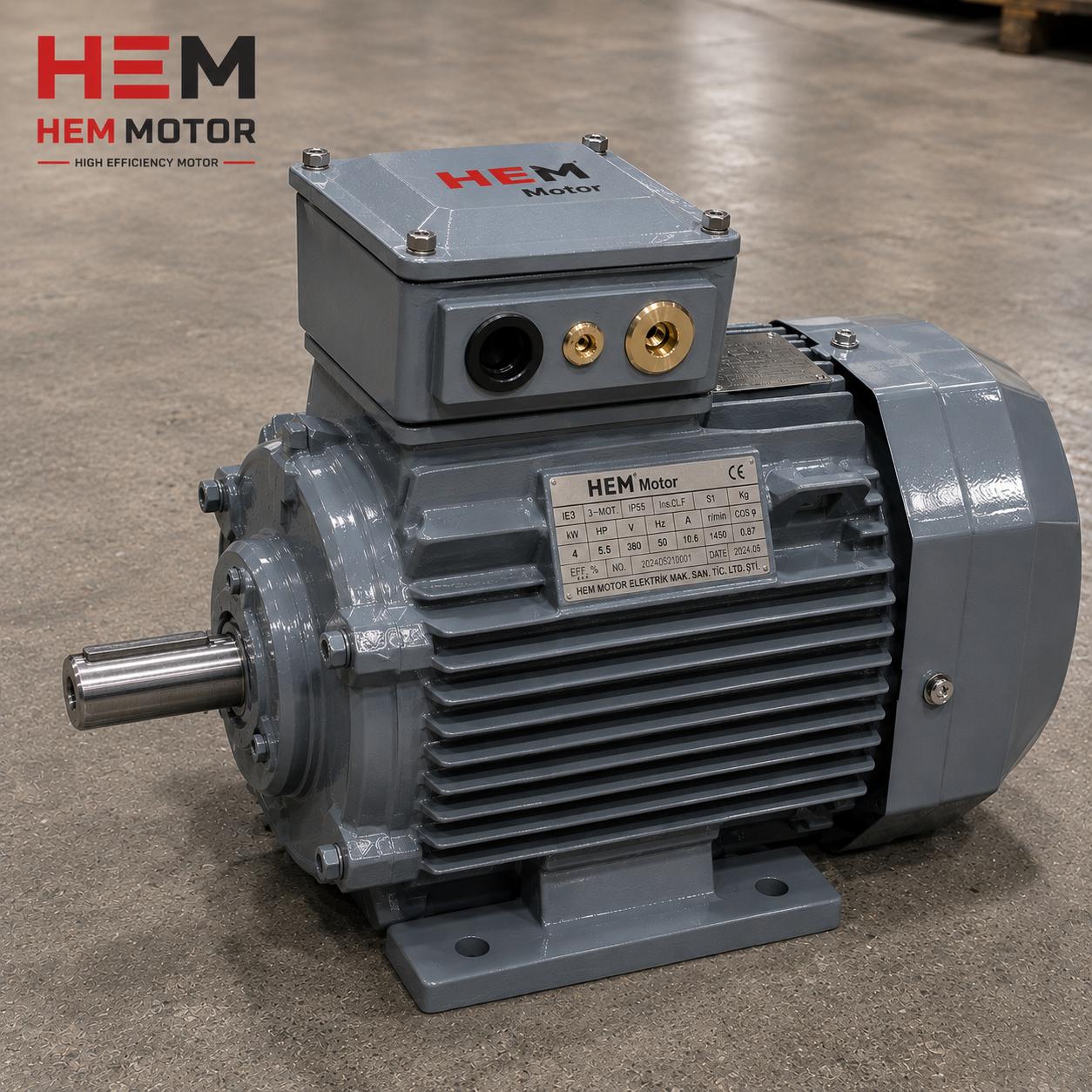
High-efficiency IE4 motors offer an advantage in the reactive equation in two ways. First, because they operate with lower losses, they do the same work with less active power; this directly reduces kWh consumption. Second, thanks to their optimized magnetic design, they generally exhibit a better power factor, especially near full load. In other words, an IE4 motor has the potential to improve both the active bill and the reactive load at the same time.
But here one must be realistic: no asynchronous motor alone can reach cos φ = 1; some reactive power always remains. Therefore the soundest approach is to use a high-efficiency motor together with compensation. The IE4 motor lowers active consumption and the base reactive load; compensation balances the remaining reactive power. Together they optimize the bill on both the active and reactive sides. For the energy dimension of correct motor selection, our content on the carbon footprint of a high-efficiency motor is also a related resource.
Harmonics and a New Dimension in Modern Plants
In today's plants, motors are often connected not directly to the grid but through variable frequency drives (VFDs). A frequency drive generally keeps the motor's power factor high on the grid side, which is an advantage. However, drives also send harmonic currents to the grid. Harmonics create a distortion that does not appear in the classic cos φ table but still pollutes the grid and stresses the transformer. Therefore, in a modern plant, reactive management must cover not only classic compensation but also harmonic control.
- Harmonic filter: Filters the harmonics produced by drives, protecting the grid and the capacitors.
- Detuned (reactor) compensation: Prevents capacitors from resonating with harmonics.
- Correct drive selection: Low-harmonic drives (e.g. active front end) reduce pollution from the start.
In motors driven by a frequency drive, the reactive and harmonic equation must be evaluated together. Our content on driving an asynchronous motor with a VFD covers the effects of drives on the motor and the grid in detail.
Correct Sizing: The Cheapest Measure
The cheapest way to reduce reactive cost is to size the motor correctly. Choosing an oversized motor "just in case" runs it continuously at partial load and low power factor. A motor sized to the real value of the load both operates at a higher cos φ and consumes less energy.
- Measure the load; choose the motor according to real need, without exaggeration.
- Review motors that run continuously at partial load.
- Consider replacing old, low-efficiency motors with IE4.
- Have the reactive relay of your compensation panel checked regularly.
At HEM Motor, we supply correctly rated, high-efficiency motors suited to your plant's load profile from our wide stock. For the right motor selection that will lower your energy costs, you can visit our homepage.
Frequently Asked Questions
Why is the reactive penalty thought to be invisible on the bill?
Because facilities generally track active consumption (kWh) and overlook the reactive item. The reactive penalty appears as a separate line on the bill and reaches a serious annual amount in plants running many low cos φ motors. With regular monitoring and compensation, this item can be largely eliminated.
Does an IE4 motor eliminate the reactive penalty entirely?
No. An IE4 motor lowers active consumption and generally offers a better power factor, but no asynchronous motor alone can reach cos φ = 1. The most effective solution is to use the high-efficiency motor together with compensation; in this way the remaining reactive power is also balanced and the penalty is managed.
Why does choosing an oversized motor lower the power factor?
Because the reactive power a motor draws to build its magnetic field is not very load-dependent and is largely constant. If a motor is chosen oversized and runs continuously at partial load, useful work decreases but reactive consumption continues, which lowers the power factor. Correct sizing reduces both the reactive load and the investment cost.