English
 Türkçe

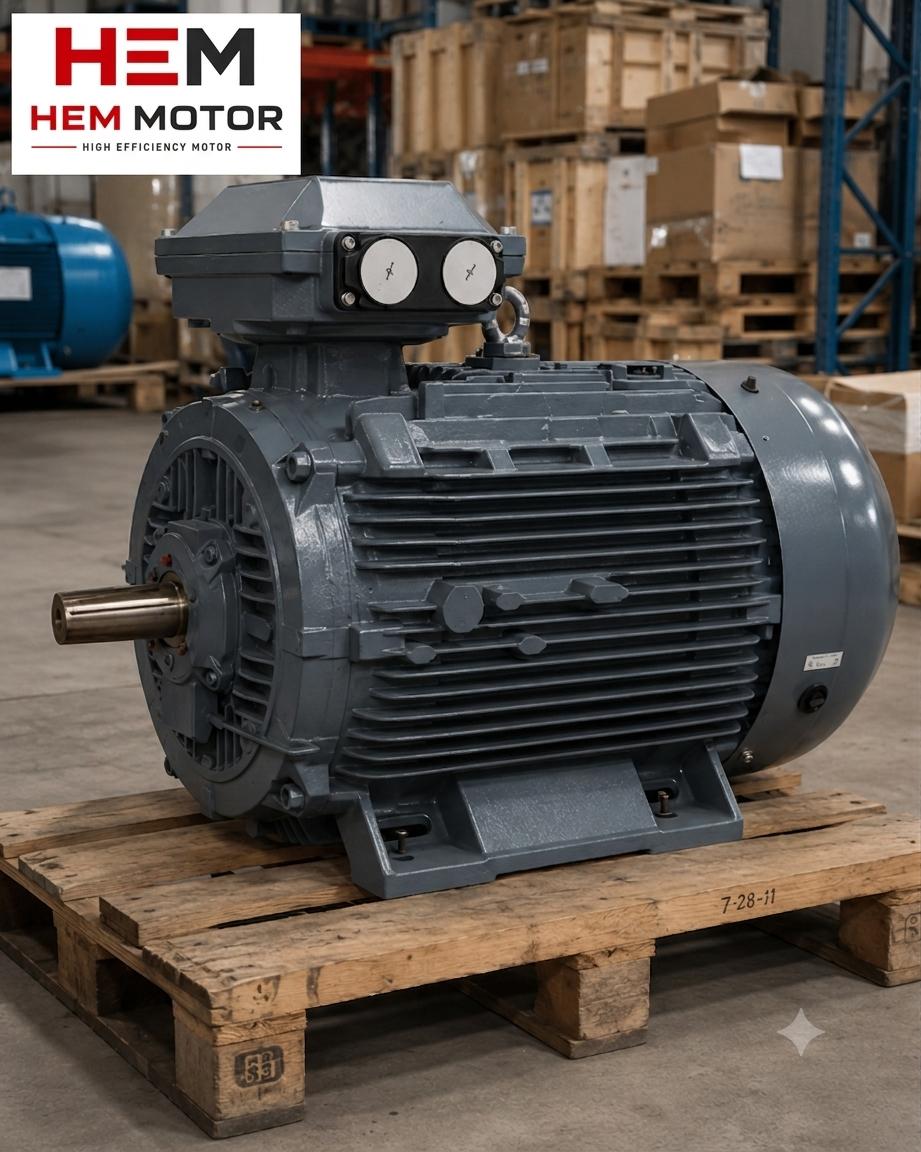

The most critical mechanical part determining the life of an asynchronous motor is often the bearing. When a motor fails, the cause is, in most cases, not the winding but a worn or damaged bearing. Selecting the correct bearing type, applying the correct greasing, and especially taking measures against bearing currents in motors running with a frequency drive (VFD) directly affect how many years the motor will last in the field. As HEM Motor, with our identity as both manufacturer and supplier, we provide asynchronous motor and three-phase motor solutions with heavy-duty bearing structures, together with insulated bearing and drive compatibility options when needed. This guide addresses bearing types, greasing, bearing currents with VFDs, and insulated bearings/grounding brushes from a purchasing and life perspective.

Bearing Types in an Asynchronous Motor
The two most common bearing types in asynchronous motors are ball bearings and roller (cylindrical) bearings. Which one is needed depends on the motor's load type and connection method.
Ball (Deep-Groove Ball) Bearings
Most standard industrial motors are equipped with deep-groove ball bearings on both sides. This type can carry both radial and, to a certain extent, axial load, and is suitable for directly coupled applications. With its quiet, balanced operation and wide range of use, it is the most preferred type. If you will connect the motor by coupling, the shaft and key fit must also be correct; we addressed this in our shaft diameter, key and coupling in cast iron motors article.
Roller (Cylindrical) Bearings
In applications connected by belt-pulley and bearing high lateral (radial) load, a roller bearing is preferred on the drive side. The roller bearing carries high radial load far better than a ball bearing and withstands the strain created by belt tension for a long time. This type is important in conveyor, crusher and high-power drive applications. You can examine how bearing and journal life is a quality indicator in purchasing cast iron motors in our bearing and journal life in cast iron motors article.
Greasing and Bearing Life
Bearing life is closely tied to correct lubrication. In small and medium-power motors, bearings usually come lifetime-lubricated (sealed type) and require no maintenance. Large-power motors have externally greasable (with grease nipple) structures and need re-greasing at certain intervals.
Wrong grease type, too much or too little grease are the main causes that shorten bearing life. Too much grease creates heat and friction; too little grease causes metal-to-metal contact. The correct greasing interval and amount must be applied according to the manufacturer's data. We addressed the effect of regular maintenance on motor life in our electric motor maintenance and periodic check schedule article, and the early signs of bearing failure in our electric motor failures: symptoms, causes article. Abnormal noise and vibration are often the first herald of bearing failure; we detailed the topic of noise and vibration in our noise and vibration in electric motors article.

Bearing Currents in Operation with a Frequency Drive (VFD)
Running an asynchronous motor with a frequency drive (VFD) provides speed control and energy savings; however, it also brings a special risk for the bearings: bearing currents. The drive produces a very rapidly switched voltage at its output. This voltage can create an unwanted voltage on the motor shaft; when this voltage exceeds a certain threshold, it punctures the bearing's oil film and discharges with a spark. This phenomenon is called electrical erosion (the EDM effect).
Bearing currents form microscopic pits and grooves (fluting) on the bearing races and balls over time. This damage leads the bearing to premature failure, often producing the typical picture of "premature bearing failure in a VFD-driven motor." We addressed when a frequency drive is needed and how it is selected in our frequency drive (VFD) with an asynchronous motor article. When buying a motor that will run with a VFD, planning the measure against bearing currents from the start is the most correct approach.
The most insidious aspect of bearing current risk is that it appears when the motor, which runs fine on plain mains, is connected to the drive. Therefore, testing the same motor on the mains first and thinking "there is no problem" can be misleading; the real risk emerges when continuous operation with the drive begins. The damage develops not suddenly but accumulating over months; so even if the motor runs trouble-free for a few months, bearing current may be quietly wearing the bearing. For this reason, planning the measure at the purchasing stage rather than afterwards is far more economical for motors that will run with a drive, because removing, repairing and reinstalling a motor that fails in the field is a loss of both time and cost.
Solution: Insulated Bearing and Grounding Brush
There are two basic methods to prevent the damage caused by bearing currents, and they are generally chosen according to the position to which the motor is connected.
Insulated Bearing
An insulated bearing is a solution with a ceramic-coated outer race or ceramic balls (hybrid) that physically prevents current passing from the shaft to the body. It is generally applied to the bearing opposite the drive side (the rear one); thus the current path is broken and discharge through the bearing is prevented. In high-power motors running continuously with a VFD, an insulated bearing significantly extends life.
Grounding Brush (Shaft Grounding)
A grounding brush is a solution that transfers the voltage accumulating on the shaft to the body (ground) through a safe path instead of through the bearing. A conductive brush contacting the shaft discharges the current harmlessly and protects the bearing. Correct grounding is critical for both bearing currents and general electrical safety; we explained correct grounding in our grounding and electrical safety in cast iron motors article. In some applications, an insulated bearing and a grounding brush are used together.
Other Causes That Shorten Bearing Life
Although bearing currents are a significant risk in VFD systems, they are not the only cause of bearing failure. The most common other causes encountered in the field are:
- Faulty mounting and alignment: If the coupling or pulley is not correctly aligned, a constant strain forms on the shaft and the bearing wears prematurely. Correct alignment is the most basic condition of bearing life.
- Excessive belt tension: Over-tensioning the belt in a belt-pulley connection puts excessive radial load on the drive-side bearing and shortens its life.
- Vibration and impact load: In impact-load applications like crushers, the bearing is constantly exposed to sudden loads; roller bearings and a strong bearing structure are preferred in such applications.
- Overheating: If the motor runs continuously at overload, the bearing temperature rises, the grease life shortens and the bearing fails prematurely.
- Dust and moisture ingress: Dust and moisture entering the bearing area spoil the grease and wear the metal surfaces. Therefore correct sealing and IP protection class also protect bearing life.
Most of these causes can be prevented with correct motor selection and correct mounting. We compiled the general causes of premature motor failure and how to judge quality when buying in our electric motor lifespan and the 7 causes of premature failure article.
Bearing Check on Stock and Standby Motors
In motors that have been in stock for a long time or have stood idle, the bearing should be checked before the first start. In a bearing that has stood without turning for a long time, grease can collect at one point and moisture can accumulate. It is useful to turn the shaft by hand before the first start to check for any abnormal binding or noise. Likewise, measuring the insulation resistance (megger test) in a long-idle motor is important; we addressed this check in our insulation resistance and megger test in asynchronous motors article. Checking the rotation direction and phase sequence during commissioning is also necessary to avoid damaging the bearing and mechanical system; we explained this in our motor rotation direction and phase sequence article.
Correct Asynchronous Motor Supply
The bearing is the critical part determining the life of an asynchronous motor; however, the correct pole count, torque class and body structure are also important in selection. We addressed pole selection in an asynchronous motor in our asynchronous motor buying guide: 2, 4, 6 poles article, and torque classes in our asynchronous motor torque classes (Design N/H) article. You can examine all high-efficiency electric motors, IE3 electric motor and IE4 electric motor options and mounting types on our products page, and all our guides on asynchronous and AC motors in our asynchronous/AC motors section.
Frequently Asked Questions
Does a motor running with a VFD necessarily need an insulated bearing?
It is not mandatory on every motor; however, as power grows and the motor runs continuously with the drive, the bearing current risk increases. Generally, an insulated bearing or grounding brush is recommended on motors above a certain power rating that run continuously with a VFD. In low-power applications that rarely use a drive, the risk is lower. The most correct approach is to share the motor's power and how it runs with the drive with us; we then recommend the bearing current measure according to the application.
How do I tell bearing failure early?
The most typical signs are increasing noise in the motor, an abnormal hum or metallic sound, increasing vibration and heating in the bearing area. Intervening when these signs appear prevents the bearing from completely locking up and damaging the shaft and winding. Monitoring vibration and temperature in periodic maintenance gives the opportunity to replace the bearing during a planned shutdown; a controlled maintenance is always more economical than an unexpected failure.
Is it more sensible to replace the bearing or renew the motor?
This depends on the motor's power, age and general condition. Bearing replacement may be sensible on a high-power, relatively new motor. However, on low-power motors or motors whose winding is also worn and that have been repaired many times, buying a new motor is often more economical, because a new motor brings both warranty and higher efficiency. When deciding, you should evaluate the motor's overall condition and future reliability.
Get a Quote
Let us determine together the right motor with the bearing structure suited to your application, with insulated bearing or grounding brush options when needed. Share the motor's power, connection method (coupling/belt) and whether it will run with a drive; we will recommend the suitable asynchronous motor solution. For an immediate quote, reach us through our contact page or call our line at +90 (532) 345 49 86. HEM Motor stands by you in long-lasting and reliable motor supply.